
5 Grammar Rules That Guarantee Points on the Digital SAT
Tips

Kenneth Liu
The Reading & Writing section of the Digital SAT can feel subjective. Sometimes, it feels like you are guessing what the author "implied."
But there is one part of the section that is 100% objective, black-and-white, and predictable: Standard English Conventions (Grammar).
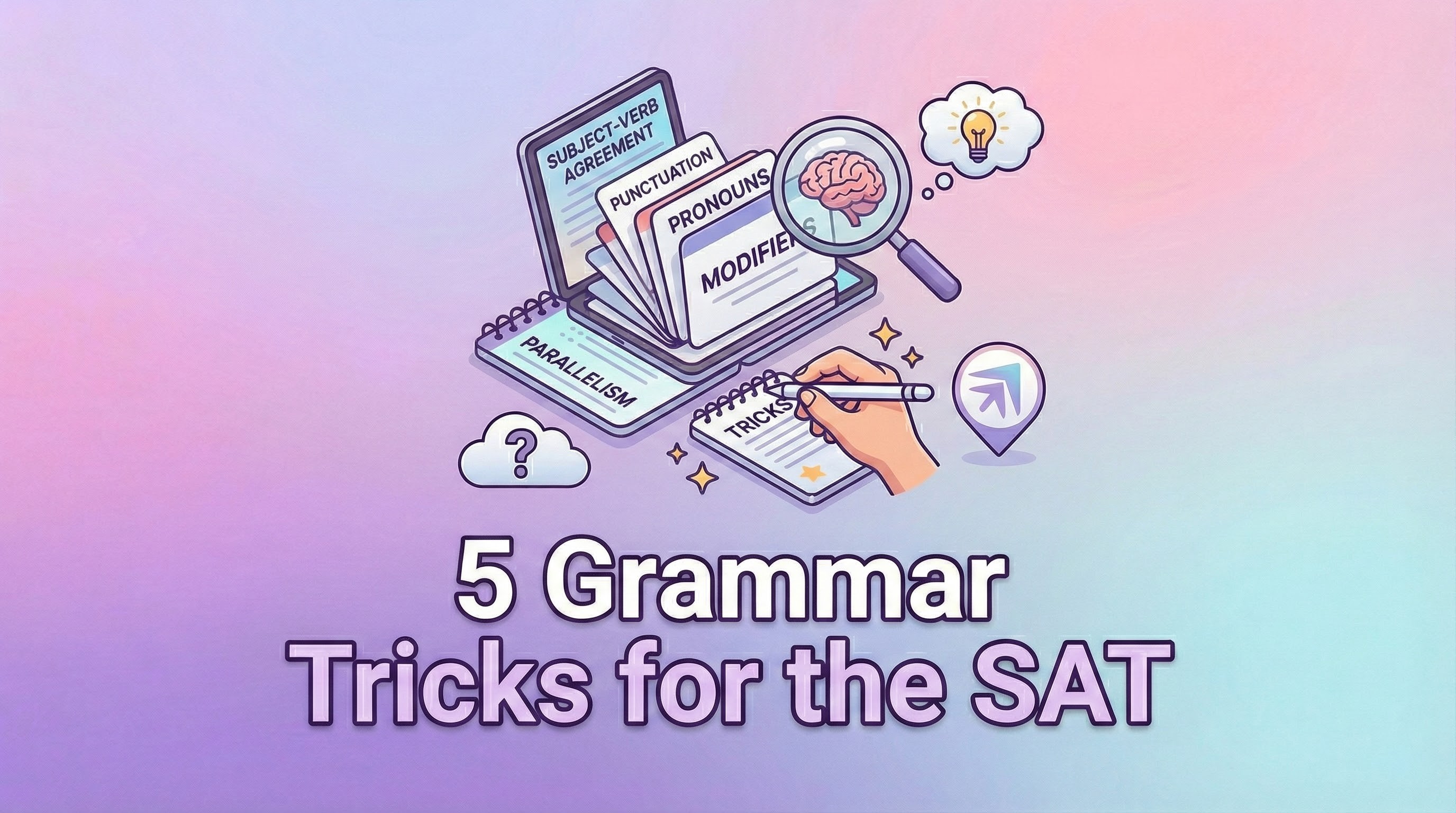
There is no "interpretation" here. A semicolon is either right, or it’s wrong. If you master these rules, you essentially get "free points" that buffer you against the harder vocabulary questions. Here are the 5 rules you must know.
1. The "Period = Semicolon" Hack
This is the easiest trick on the test.
Grammatically, a period (.) and a semicolon (;) do the exact same thing: they separate two independent clauses (complete sentences).
The Hack: If you see two answer choices that are identical except one uses a period and the other uses a semicolon, both of them are wrong. Eliminate them immediately.
Choice A: ...the dog ran. He was fast.
Choice B: ...the dog ran; he was fast.
Verdict: Cross them both out. The answer is likely C or D.
2. The Dangling Modifier
The SAT loves this error.
Rule: When a sentence starts with a descriptive phrase followed by a comma, the noun immediately after the comma must be the thing being described.
Wrong: Walking down the street, the trees looked beautiful. (The trees were not walking.)
Right: Walking down the street, I thought the trees looked beautiful.
Always look at the subject after the comma. Does it make sense?
3. The "False Subject" Trap
Subject-Verb agreement seems easy ("He runs" vs "They run"), but the SAT hides the subject to trick you. They put a "prepositional phrase" between the subject and the verb.
Trick: The box of apples are heavy. (Your ear hears "apples are").
Reality: The box [of apples] is heavy.
Ignore everything between the subject and the verb. Cross out the prepositional phrase to find the true subject.
4. Punctuation Hierarchy
You can often solve questions just by knowing the "strength" of punctuation marks.
Period / Semicolon: Strongest. Separates two full sentences.
Colon / Single Dash: Medium. What comes before must be a full sentence. What comes after can be a list or explanation.
Comma: Weakest. Cannot separate two full sentences alone (that’s a "Comma Splice").
5. "Non-Essential" Information
If a phrase is surrounded by commas (or dashes/parentheses), it is non-essential. You should be able to lift it out of the sentence and the sentence should still make sense.
Example: Mr. Jones, who is my teacher, is nice.
Check: Mr. Jones is nice. (It works).
If the sentence breaks when you remove the phrase, you cannot use commas around it.
Conclusion
Grammar questions are the "math" of the English section. They follow formulas. Once you memorize these patterns, you stop guessing and start knowing.
Now that you have the grammar rules locked down, make sure you aren't losing points on the Words in Context questions.
Want to drill these specific grammar rules? SuperScored identifies exactly which rule you are missing and gives you targeted practice to fix it.

March 14, 2026
Your next SAT
is closer than you think.
Take the free 35‑minute diagnostic now. Get your exact score, a one‑page cheat sheet, and what to study next.
© 2026 SuperScored. All rights reserved.